
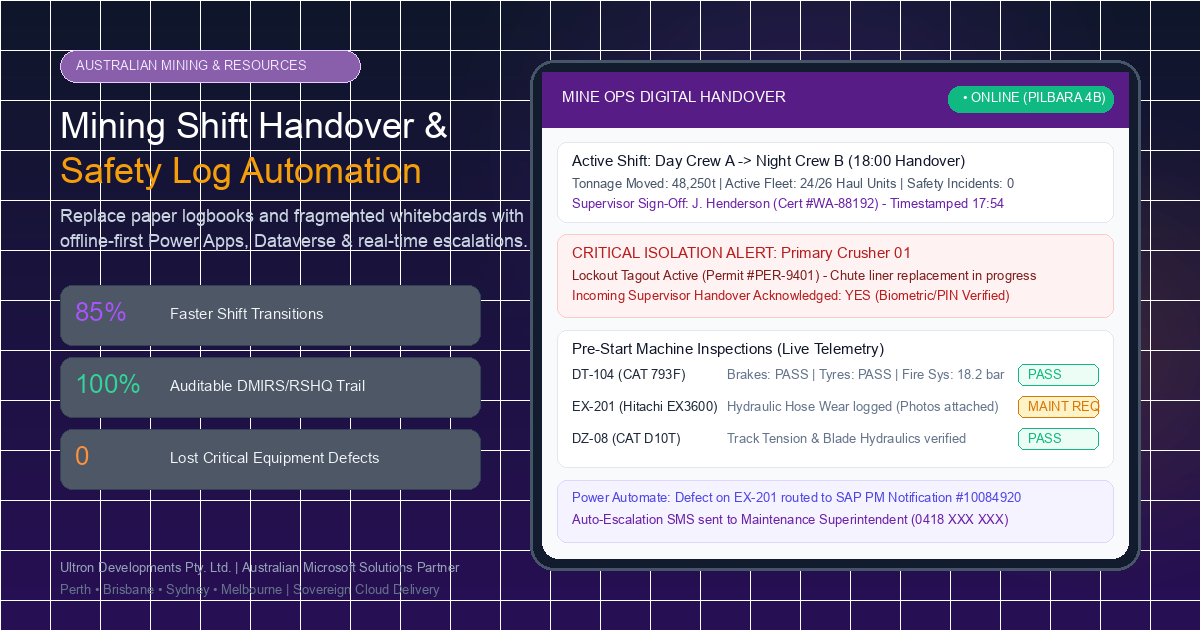
Modernized digital pre-start inspections, critical isolation tracking, and automated shift handovers deployed on rugged tablets across Australian mine sites.
In open-cut iron ore pits in the Pilbara, underground hard-rock operations in the Goldfields, and coal handling preparation plants (CHPP) across Queensland's Bowen Basin, the shift handover window is the single most vulnerable 30 minutes in the 24-hour mining operational cycle.
When critical safety observations, uncompleted Lockout/Tagout (LOTO) isolations, geotechnical wall movements, or machine component defects are communicated through illegible carbon-copy books, grease-stained log sheets, or verbal hallway briefings between Fly-In Fly-Out (FIFO) crews, catastrophic blindspots occur.
The Mining Regulatory Reality (WA DMIRS & QLD RSHQ)
Under the Work Health and Safety (Mines) Regulations 2022 (WA) and the Coal Mining Safety and Health Act 1999 (QLD), statutory mine managers and shift supervisors bear personal and organizational liability for maintaining an unbroken, verifiable audit trail of hazard transfers, hot-work permits, and equipment isolations across every shift changeover.
The 5 Fatal Failure Modes of Traditional Paper Handovers
Despite massive investments in autonomous haulage and telemetry, over 65% of Australian mine sites still rely on manual paper logbooks or disconnected desktop Excel sheets at the shift changeover desk. This creates five distinct operational failure modes:
- Uncommunicated Lockout & Isolation States: An outgoing mechanical crew isolates a conveyor drive head for chute repairs. If the paper permit isn't physically handed over or is obscured on a clip rail, the incoming shift risks energizing machinery with contractors still in the line-of-fire.
- "Pencil-Whipped" Pre-Start Walkarounds: Heavy equipment operators rushing to hit haul quotas check off paper inspection sheets without conducting thorough walkarounds. Hydraulic leaks, cracked wheel rims, and declining fire suppression pressure go unflagged until catastrophic failure causes millions in unplanned downtime.
- Geotechnical & Environmental Blindspots: Berm cracking, blast exclusion perimeter updates, and sudden water table ingress recorded in a supervisor's field notebook fail to reach the incoming blast master or pit supervisor before dispatching loaders.
- Zero Integration with Enterprise CMMS (SAP PM / Maximo): Paper defects sit in a tray in the crib room for up to 72 hours before a clerk manually types them into SAP PM or Ellipse. By then, equipment has suffered secondary damage.
- Loss of Institutional Context During FIFO Roster Swaps: When Crew A flies out on Tuesday and Crew B flies in, critical nuance regarding chronic machine vibrations or plant bottlenecking is lost, restarting the diagnostic cycle from zero.
Architecting an Enterprise Shift Handover & Safety Solution
At Ultron Developments, we architect end-to-end digital handover ecosystems leveraging the Microsoft Power Platform and Microsoft Dataverse, engineered specifically for rugged regional Australian mining environments.
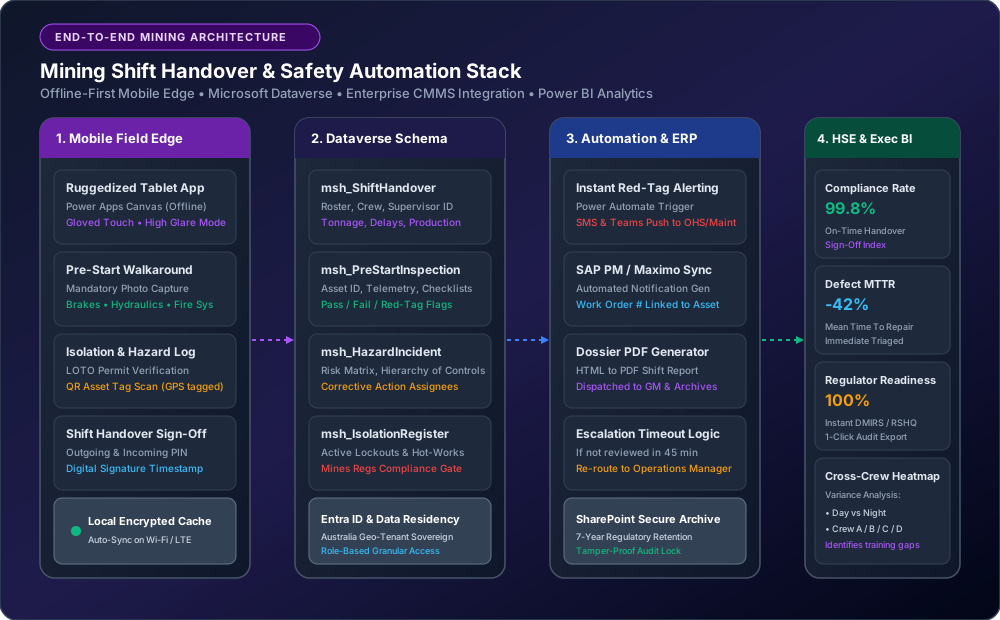
Figure 1: Four-tier architecture connecting rugged field tablets, Dataverse relational schema, Power Automate ERP integration, and Power BI executive dashboards.
Tier 1: Ruggedized Offline Mobile Edge (Power Apps Canvas)
Frontline operators work in harsh environments—extreme heat, red iron ore dust, and complete cellular blackspots inside pit floors or underground declines. The front-end application is designed with:
- Glove-Friendly Touch Targets: Extra-large buttons (minimum 64px tap targets) and high-contrast color palettes (optimised for 1,000+ nits daylight readability on rugged Samsung Active Tab / Panasonic Toughbook hardware).
- Native Offline-First SQLite Caching: Mandatory checklists, equipment registers, and hazard forms operate with 100% functionality without internet connection, queuing encrypted payload deltas locally.
- Photo Capture with On-Screen Visual Markup: Operators snap high-resolution photos of hydraulic hose chafing or tire sidewall cuts, draw digital arrows over the defect area, and speak hazard notes using native on-device speech-to-text.
- Asset Tag Barcode & NFC Scanning: Operators scan the physical asset tag on the truck or pump skid to immediately pull historical maintenance logs and open work orders.
Tier 2: Relational Data Model (Microsoft Dataverse)
Unlike flat SharePoint lists that hit 5,000-item delegation limits and lack transactional integrity, we model mining operational data in Microsoft Dataverse using strict relational schemas:
| Dataverse Table | Primary Attributes | Business & Statutory Function |
|---|---|---|
| msh_ShiftHandover | ShiftID, Date, ShiftType (Day/Night), CrewID, OutgoingSupervisorID, IncomingSupervisorID, TonnageMoved, TotalDelays, HandoverStatus | Primary parent record capturing production telemetry, weather, and supervisor e-signatures. |
| msh_PreStartInspection | InspectionID, AssetTag, OperatorID, EngineHours, BrakesPass, FireSysBar, DefectSeverity (Green/Yellow/Red), SyncTimestamp | Time-stamped pre-dispatch walkaround records with mandatory photographic evidence. |
| msh_IsolationRegister | IsolationID, PlantLocation, LOTO_PermitNumber, LockBoxTag, IsolatedBy, ActiveFlag, IncomingAcknowledgeFlag | Mandatory safety barrier ensuring no shift handover can close while open isolations are unacknowledged. |
| msh_HazardIncident | HazardID, RiskRating (1-5), GeotechnicalArea, ImmediateActionTaken, CorrectiveActionAssignee, GPS_Coordinates | Site hazard and near-miss logging with automated hierarchy-of-control routing. |
Tier 3: Automated Workflow & CMMS Integration (Power Automate)
Data capture is only half the battle; real-time operational response is what prevents safety incidents and plant outages:
- Instant "Red-Tag" Equipment Lockout Escalation: When an operator logs a Class-1 safety defect (e.g. steering hydraulic fault), Power Automate immediately flags the asset as "QUARANTINED" in Dataverse, triggers an automated SMS to the Mine Superintendent, and pushes a high-priority card to the site maintenance Microsoft Teams channel.
- Bi-Directional SAP PM / IBM Maximo Work Order Creation: Through Azure API Management or custom REST connectors, failed pre-start checks automatically create a PM Notification in SAP, passing defect notes, photos, and machine telemetry without human re-entry.
- Shift Handover PDF Dossier Generation: Upon mutual digital sign-off by both outgoing and incoming supervisors, a cloud flow compiles the entire shift's production metrics, open isolations, active permits, and safety flags into a standardized PDF dossier archived in a locked SharePoint repository with a 7-year regulatory retention policy.
Tier 4: Executive Visibility & HSE Compliance (Power BI)
Operational data streams into enterprise Power BI dashboards, giving General Managers and HSE Directors real-time analytics across:
- Cross-Crew Handover Variance: Benchmark pre-start defect catch rates and handover completion times across Crew A, B, C, and D to identify training opportunities.
- Defect MTTR (Mean Time to Repair): Track the exact elapsed time from an operator logging a defect on a mobile tablet to maintenance close-out in SAP PM.
- Regulatory Audit Readiness: Export instant 100% compliant handover dossiers during unannounced DMIRS/WorkSafe WA or RSHQ inspections with single-click filtering.
Modernize Your Mine Site Shift Handover & Safety Workflows
Speak directly with our Australian Microsoft solution architects based in Perth (AWST) and Brisbane (AEST). We'll audit your current paper/spreadsheet handover logs and deliver a fixed-scope implementation roadmap for an offline-capable Power Apps solution.
Comparing Operational Approaches: Paper vs. Spreadsheets vs. Ultron Digital Stack
How does a bespoke, governed Microsoft Power Platform solution compare against traditional paper clipboards and unmanaged Excel sheets?
| Capability | Paper Logbooks | Spreadsheets / Forms | Ultron Power Apps Solution |
|---|---|---|---|
| Offline Reliability | Physical only (easily lost/damaged) | Fails without active site network | Native encrypted SQLite offline sync |
| Shift Handover Synthesis Time | 35–50 minutes manual writing | 20–30 minutes manual copy-paste | 5–8 minutes automated roll-up |
| Isolation & LOTO Verification | High Risk (verbal handover) | Partial (unverified checkboxes) | Mandatory digital sign-off gate |
| CMMS / ERP Integration | Manual batch entry (2–3 days lag) | CSV import scripts (fragile) | Real-time SAP PM / Maximo API sync |
| Defect Photo Documentation | None | Separate camera SD card dump | In-app photo capture with markup |
| Statutory Audit Readiness | Hours searching paper filing cabinets | Scattered across multiple shared drives | 1-Click immutable 7-year PDF archive |
Our 4-Phase Field Implementation Methodology
Rolling out technology to FIFO mining workforces requires rigorous user-centered design, deep alignment with site HSE processes, and zero operational disruption:
Site Process Mapping & Statutory Risk Standardization (Weeks 1–2)
Our consultants analyze your current shift handover templates, pre-start checklists, isolation registers, and hot-work permits. We standardize the data taxonomy and align workflows directly with your site safety management system (SMS) and state regulations (WA DMIRS / QLD RSHQ).
Rugged UX Design & Offline Dataverse Sync Engine (Weeks 2–3)
We build custom Canvas Power Apps with high-glare UI modes, glove-touch controls, camera markup tools, and fine-tuned offline synchronization profiles. We test sync bandwidth consumption over low-throughput remote satellite connections.
Automated CMMS Integration & Instant Escalations (Weeks 3–4)
We configure Power Automate cloud flows to route critical red-tag equipment defects straight into SAP PM, Ellipse, or Maximo, dispatch automated SMS alerts to superintendents, and generate signed shift handover PDF dossiers.
FIFO Crew Pilot, Onboarding & Full Site Cutover (Weeks 4–5)
We conduct a 2-week pilot with one active FIFO swing (Day & Night crews). Based on direct supervisor feedback, we optimize tap flows, validate tablet durability, and roll out to all site departments with zero downtime.
Proven Value in Australian Mining Operations
Ultron Developments has extensive experience architecting mission-critical field solutions across the Australian resources sector. For example, our work with Metro Mining modernized complex, multi-path procurement and operational requisitions across remote bauxite operations, eliminating manual processing bottlenecks and establishing complete auditability.
On production mine sites, digitizing shift handovers and pre-start inspections delivers measurable returns:
- 85% Reduction in Handover Synthesis Time: Shift supervisors reclaim 45+ minutes per shift previously lost to manual transcription, enabling more time on the ground coaching crews.
- 42% Faster Defect Resolution (MTTR): Critical equipment defects are routed instantly into maintenance queues, preventing secondary component failures on multi-million dollar haul fleets.
- 100% Statutory Compliance: Elimination of lost inspection books, missing signatures, or unresolved isolation queries during DMIRS/RSHQ compliance audits.
Frequently Asked Questions (FAQ)
How does the app work underground or in deep pit blackspots?
The solution is architected as an offline-first Power Apps Canvas app with local encrypted SQLite storage on the rugged tablet. Crews complete pre-start checks, record photos, and log shift handovers completely offline. When the tablet enters vehicle Wi-Fi range or LTE coverage at the crib hut, all queued records synchronize automatically in the background with delta conflict resolution.
Can we integrate with our existing SAP PM or IBM Maximo system?
Yes. We build secure REST API integrations using Power Automate and Azure API Management to connect directly to SAP PM, IBM Maximo, or Hitachi Ellipse. Failed pre-starts automatically create maintenance work orders with defect photos, GPS location, and severity ratings, while maintenance completion status flows back to the operator tablet.
How do we manage access for temporary FIFO contractors?
Authentication is governed through Microsoft Entra ID (Azure AD). We configure role-based access control (RBAC) so that contractor operators only see their assigned fleet inspections, while shift supervisors and superintendents have permissions to review, modify, and authorize shift handover sign-offs.
What rugged tablet hardware do you recommend?
We recommend ruggedized field devices such as the Samsung Galaxy Tab Active5 Pro (Android) or Panasonic Toughbook G2 (Windows). Key specifications include IP68 dust/waterproofing, MIL-STD-810H vibration resistance, glove-compatible touchscreen modes, and 1,000+ nits display brightness for Australian sunlight readability.
How fast can we launch a proof-of-concept pilot?
Our team delivers a working pilot on test rugged tablets in 3 to 4 weeks, including core pre-start checklists, isolation registers, offline sync profiles, and supervisor approval flows.
Ready to Eliminate Paper Across Your Mine Sites?
Work with our certified Australian Microsoft architects to design, prototype, and deploy offline-first mobile apps for your FIFO and site crews.